What Is CBD Coffee? The Complete Guide to Functional Coffee in 2026
CBD coffee is exactly what it sounds like: specialty coffee that has been infused with cannabidiol, a non-intoxicating compound derived from hemp. But that simple definition undersells what makes it genuinely different from the cup you've been drinking. The reason people switch to CBD coffee, and stay with it, is not just the addition of a new ingredient. It's the way the combination changes how caffeine actually feels in your body.
This guide covers everything: what CBD coffee is, how it works, how it's made, what separates a quality product from a gimmick, and why the functional coffee movement is growing so fast. If you've been curious about CBD coffee but weren't sure where to start, this is the place.
The Basic Definition: What Is CBD Coffee?
CBD coffee is specialty-grade coffee that contains cannabidiol (CBD), a compound found in hemp plants. CBD is non-psychoactive, meaning it does not produce a high. It contains no more than 0.3 percent THC by dry weight, which is the federally legal limit under the 2018 Farm Bill, and it is legal to buy and sell throughout the United States (USDA, 2018 Farm Bill).
At its core, CBD coffee is a functional beverage. Functional beverages are drinks formulated to deliver a specific benefit beyond basic nutrition or hydration. Think of electrolyte drinks, adaptogen teas, or probiotic sodas. CBD coffee fits into this category because the goal is not just to provide caffeine, but to change the quality of the energy and focus that caffeine delivers.
The market has grown significantly in recent years. Consumers, particularly in wellness-forward cities like Los Angeles, San Francisco, Austin, and New York, are increasingly looking for ways to get the benefits of their morning coffee without the side effects that come with it. CBD coffee has become one of the primary answers to that search.
How CBD and Caffeine Work Together
To understand why CBD coffee works differently, you need to understand what caffeine does on its own and what CBD adds to the equation.
What Caffeine Does in Your Body
Caffeine works by blocking adenosine receptors in your brain. Adenosine is a neurotransmitter that accumulates throughout the day and signals fatigue. By blocking those receptors, caffeine keeps you alert and delays the sensation of tiredness. This is effective, but it comes with trade-offs.
When caffeine activates your nervous system, it also triggers a stress response. Cortisol rises. Heart rate increases. For people who are already sensitive to stimulation, that cascade can tip into anxiety, restlessness, or a wired feeling that makes it hard to focus on a single task. This is the familiar caffeine jitter problem, and it is more common than most people realize.
What CBD Adds to the Equation
CBD interacts with the body's endocannabinoid system, a regulatory network that plays a role in managing mood, stress response, inflammation, and nervous system balance (Iffland and Grotenhermen, 2017). CBD does not block receptors the way caffeine does. Instead, it modulates the system, helping to keep it regulated rather than pushing it into overdrive.
When you combine CBD with caffeine, what many people experience is a smoother, more grounded form of alertness. The energy is there. The focus is there. The edge, the anxiety, the jitters, the mid-morning crash: those tend to be reduced. People who drink CBD coffee regularly often describe the feeling as being sharp without being frantic.
This is not just anecdote. Research on CBD and anxiety regulation is growing, and the compound's effect on the nervous system is one of the more studied areas in the hemp space (Crippa et al, 2018). The combination with caffeine is newer territory, but the underlying mechanisms are well established enough to explain why so many people report a qualitative difference in how they feel.
How CBD Coffee Is Made: What Separates Quality from Gimmick
Not all CBD coffee is made the same way, and the difference in production method has a direct effect on whether the product actually works.
The Spray-On Method (What Most Brands Do)
The most common approach in the CBD coffee market is to roast the coffee first and then spray or coat the grounds with CBD oil after the fact. This method is fast and inexpensive, which is why most brands use it. The problem is consistency. CBD oil sits on the surface of the grounds, which means it distributes unevenly. You may get more CBD in one cup and less in the next. The oil can also settle to the bottom of the bag. And because it's sitting on top of an already-roasted bean, it has not been integrated into the flavor profile. The result is often a cup with a vaguely earthy or oily quality that was not designed in, just added on.
Bean-Level Infusion (What We Do at Buddha Beans)
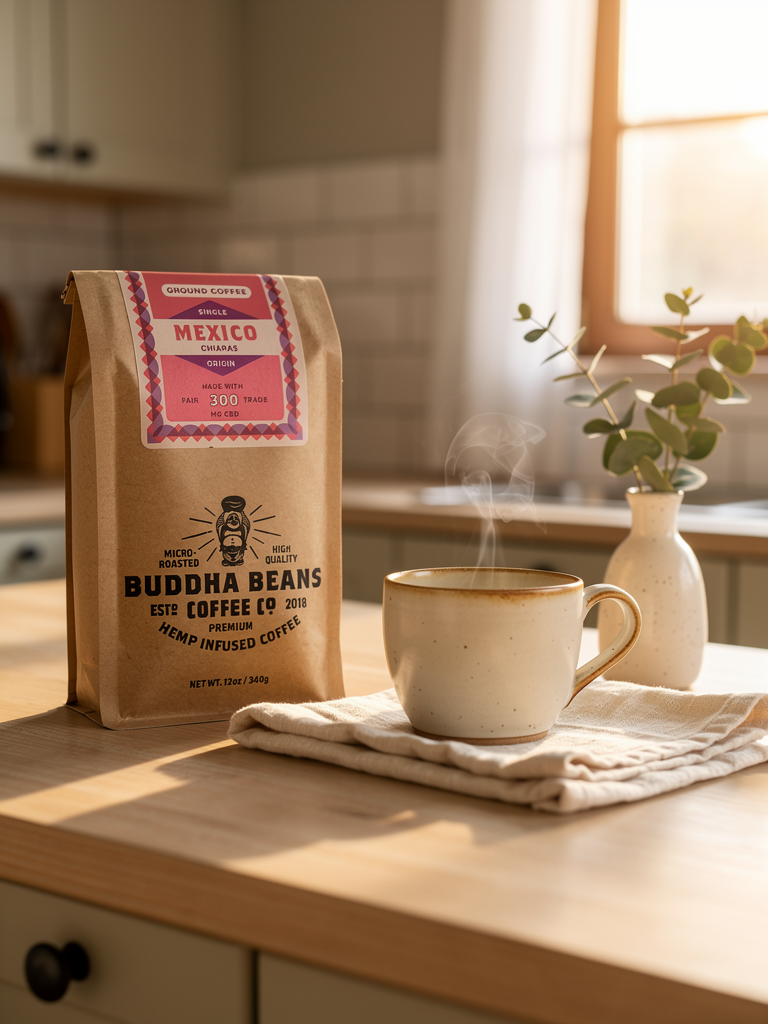
At Buddha Beans Coffee Co., we use a proprietary process that infuses CBD directly into the coffee bean itself before roasting. The CBD is embedded at the cellular level, which means it distributes evenly throughout every bean. When you grind and brew, each cup draws from that even distribution. There is no oily film, no settling, no inconsistency from cup to cup. And because the CBD is part of the bean going into the roast, the flavor integration is intentional, not incidental.
This matters if you care about both the coffee experience and getting a reliable, consistent dose of CBD in every cup you drink. Our beans are sourced from farms we know directly: single-origin lots from Ethiopia, Colombia, Burundi, and Mexico, all roasted fresh in small batches at our Los Angeles roastery.
What Is the Right CBD Dose in Coffee?
Dosing varies by product and by person. Our standard CBD coffees deliver approximately 15 to 20 milligrams of CBD per 12-ounce brewed serving. Our Black Label Colombian is formulated for higher-dose users, with around 50 milligrams per serving.
If you are new to CBD, 15 to 20 milligrams paired with a cup of specialty coffee is a reasonable starting point. The effects are subtle, not dramatic. Expect a reduction in jitters and a calmer, more sustained energy rather than any immediate or intense sensation. Most people notice the difference most clearly when they compare a day with CBD coffee to a day with regular coffee and realize they did not crash at 2pm or feel anxious at 10am.
The best approach is to start with one cup in the morning and pay attention to how you feel across the entire day, not just in the first hour.
Does CBD Coffee Get You High?
No. CBD is non-psychoactive. It will not get you high, alter your perception, or impair your ability to work, drive, or think clearly. Our products contain less than 0.3 percent THC, which is the federally legal threshold and far below any psychoactive level.
CBD and THC are both cannabinoids from the cannabis plant, but they have very different effects. THC is what produces the high associated with marijuana. CBD does not produce that effect. When people describe feeling different after CBD coffee, they are describing a reduction in anxiety and a smoother energy, not any kind of impairment.
Is CBD Coffee Legal?
Yes. Hemp-derived CBD with less than 0.3 percent THC is federally legal in the United States under the 2018 Farm Bill. All Buddha Beans CBD coffees are made with USDA Certified Organic hemp sourced from farms in Colorado and Oregon, and every batch is tested by an independent third-party lab for CBD potency, THC levels, pesticides, heavy metals, and microbials. Certificates of Analysis are available on our website for every product.
California, where our Los Angeles roastery is based, has additional regulations around hemp CBD in food and beverages. We operate in full compliance with California Department of Public Health guidelines. If you have specific legal questions about your state, the National Conference of State Legislatures maintains a current map of hemp CBD regulations by state.
Who Drinks CBD Coffee?
The people who tend to get the most out of CBD coffee share a common profile: they love coffee and want to keep it in their life, but they are dealing with side effects that regular coffee creates. Jitters, anxiety, afternoon crashes, acid reflux, or difficulty sleeping if they drink it too late.
In Los Angeles, where Buddha Beans is rooted, we see a customer base that spans creative professionals in Silver Lake and Echo Park, remote workers in Culver City and Santa Monica, fitness-focused customers in Venice and West Hollywood, and health-conscious households across the Valley and the South Bay. The common thread is that they are looking for a coffee that performs better for their particular nervous system and lifestyle.
Beyond Los Angeles, the CBD coffee audience nationally includes:
- People with caffeine sensitivity who have previously reduced or eliminated coffee
- Professionals in high-stress, high-focus work environments
- Athletes using coffee as a pre-workout or recovery tool
- People on GLP-1 medications whose digestive sensitivity has changed their relationship with regular coffee
- Wellness-oriented consumers who are already incorporating adaptogens, nootropics, or functional supplements
- Anyone who has noticed that their relationship with coffee has gotten worse as they've gotten older
CBD Coffee vs. Regular Coffee: The Key Differences
The most important differences between CBD coffee and regular coffee are not about flavor, they are about the functional experience.
Regular coffee delivers caffeine quickly and bluntly. Your cortisol spikes. Your heart rate increases. For many people this works fine. For others it becomes increasingly problematic over time, particularly as stress levels rise, sleep quality changes, or the adrenal system becomes more sensitive to stimulation.
CBD coffee delivers the same caffeine with a compound that helps your nervous system absorb and use that energy more efficiently. The energy curve is smoother. The peak is less intense but more sustained. The crash is reduced. For people who have been chasing that feeling of productive, focused energy for years, CBD coffee often turns out to be the closest thing to it they have found.
CBD Coffee vs. Mushroom Coffee
Mushroom coffee is the other major player in the functional coffee space, and it is worth understanding the difference. Mushroom coffee uses extracts from medicinal fungi like lion's mane, reishi, and cordyceps. These are legitimate functional ingredients with their own research base.
The practical distinction comes down to mechanism. Mushroom adaptogens work systemically over time, supporting stress resilience and immune function with regular use. CBD coffee works more immediately on the nervous system, modulating the caffeine response in real time. Some people find mushroom coffee more effective. Others respond better to CBD. Many people who have tried both find CBD coffee more reliable for acute focus and mood stability.
At Buddha Beans, we focus on CBD and CBG because that is where our expertise and sourcing relationships are. But we are not dismissive of mushroom coffee. The functional beverage space benefits from multiple approaches, and different bodies respond differently.
Where to Start with CBD Coffee
If you are new to CBD coffee and based in Southern California, you can find Buddha Beans at select retailers across Los Angeles, or order directly from our website with fast shipping. We roast in small batches, which means what arrives at your door was roasted recently, not sitting in a warehouse for months.
For most first-time CBD coffee drinkers, we recommend starting with one of our medium roast single-origin options. Our Mexico Organic is particularly well suited for people who have had issues with coffee acidity in the past. Our Colombia Original is a good all-around starting point if you are looking for a classic, balanced cup with CBD integrated throughout.
If you have questions about which product fits your routine, our FAQ covers dosing, sourcing, and brewing in detail. If you want to explore the full lineup, browse our CBD coffee collection here.
The Bigger Picture: Why CBD Coffee Matters Now
Coffee culture has always been about more than caffeine. It has been about ritual, community, quality, and experience. The shift toward functional coffee is a natural extension of that. People are not just asking whether their coffee tastes good. They are asking whether it makes them feel good, sustainably, without side effects that accumulate over time.
CBD coffee answers that question differently than regular coffee does. It is not a replacement for coffee, it is an evolution of it. The goal is the same: a morning ritual that sets you up for a productive, clear-headed day. The difference is that with CBD coffee, that goal is actually achievable without fighting your own nervous system to get there.
If you have been drinking coffee for years and have noticed that it works less well for you than it used to, or if you have always struggled with the anxiety and jitters but kept drinking it anyway because you need the energy, CBD coffee is worth a serious try. Start with one bag, pay attention to how you feel across a full week, and adjust from there.
Shop CBD coffee at Buddha Beans or read more on our blog about how CBD and caffeine interact, which origins we recommend for different goals, and how to get the most out of your brewing method.
These statements have not been evaluated by the Food and Drug Administration. This product is not intended to diagnose, treat, cure, or prevent any disease.
Shop CBD Coffee
Keep Reading
Frequently Asked Questions
Is CBD coffee legal?
Yes, CBD coffee is federally legal in the United States under the 2018 Farm Bill, provided it's made with hemp-derived CBD containing less than 0.3% THC. State laws vary, so check local regulations. All Buddha Beans CBD coffee is third-party lab tested and meets federal standards.
Will CBD coffee get me high?
No. CBD is non-psychoactive and does not produce intoxication. Hemp-derived CBD contains less than 0.3% THC, far below the threshold to cause a high. You'll feel alert from caffeine and calmer from CBD, but never impaired.
How much CBD is in a cup of CBD coffee?
Most quality CBD coffees deliver 10–30 mg of CBD per 8 oz cup. Buddha Beans offers both 150mg and 300mg bags (roughly 10mg and 20mg per cup, depending on brew strength). Start with one cup and adjust based on your response.
Does CBD cancel out caffeine?
No, CBD doesn't block caffeine's alertness. Instead, it appears to smooth the experience: many drinkers report reduced jitters, less anxiety, and a softer crash. You still get the focus and energy of coffee, just without the edge.
What does CBD coffee taste like?
Like high-quality specialty coffee. Properly infused CBD is nearly tasteless, you'll pick up the roast, origin notes, and natural sweetness of the beans, not a hemp flavor. Cheap CBD coffees sometimes taste grassy; premium ones don't.